
How Your RV Electrical System Actually Works (And What You Can Safely Plug In)

Let’s talk about something a little less Instagram-worthy but way more important than your campfire charcuterie board: your RV’s electrical system.
Because nothing kills the vibe faster than tripping a breaker, frying a microwave, or realizing too late that your air conditioner won't run off your “super quiet” generator.
Whether you’re new to RVing or just haven’t poked around your rig’s panel box yet, this post is here to help you understand how power flows through your RV, and what you can safely plug in without lighting up your fuse panel like it’s the 4th of July.
The Three Main Sources of RV Power
Your RV pulls power from three main sources:
Shore Power (AC) – This is when you’re plugged into an outlet at a campground or home.
Battery Power (DC) – This runs things like your lights, water pump, and fridge control panel when not plugged in.
Generator or Solar (AC/DC) – These provide supplemental power, converting to either AC or charging your battery bank.
Think of shore power and generator/solar as ways to provide AC (alternating current) electricity, like what you have at home.
Your RV batteries, on the other hand, provide DC (direct current), like a car battery.
Shore Power: 30 Amp vs. 50 Amp
Most travel trailers and smaller RVs use 30-amp service. Bigger rigs often have 50-amp hookups.
30 amps x 120 volts = 3,600 watts max
50 amps x 120 volts x 2 legs = 12,000 watts max
That means if you have a 30-amp system, you can run a combination of appliances that draw up to 3,600 watts at once.
That’s it. Turn on your A/C, microwave, and electric water heater at the same time, and you’ll find out exactly where the edge is.
Rule of thumb: If it makes heat or cold, it draws a lot of power.
DC Power: Your Batteries at Work
When you're not plugged in, things still work—thanks to your 12V battery system. This powers:
Overhead lights
Water pump
Furnace fan
Slide motors
Control boards for appliances
But it doesn't run your microwave, air conditioner, or regular wall outlets unless you have an inverter (more on that in a minute).
Your battery life depends on:
Amp-hour rating (how much power it holds)
What you’re running
Whether you’re recharging (via solar, generator, or driving)
If your lights start dimming or your water pump gets weak, your battery’s probably low.
Inverters vs. Converters: Know the Difference
These two get mixed up all the time:
A converter turns AC power into DC to charge your battery (standard in most RVs).
An inverter turns DC battery power into AC so you can use regular outlets when off-grid (not always included).
So if you’re boondocking and want to plug in a laptop or coffee maker?
You’ll need an inverter, and enough battery juice to back it up.
What You Can (and Can’t) Plug In Safely
Here’s a rough breakdown of what’s safe to run, especially if you’re on a 30-amp setup:
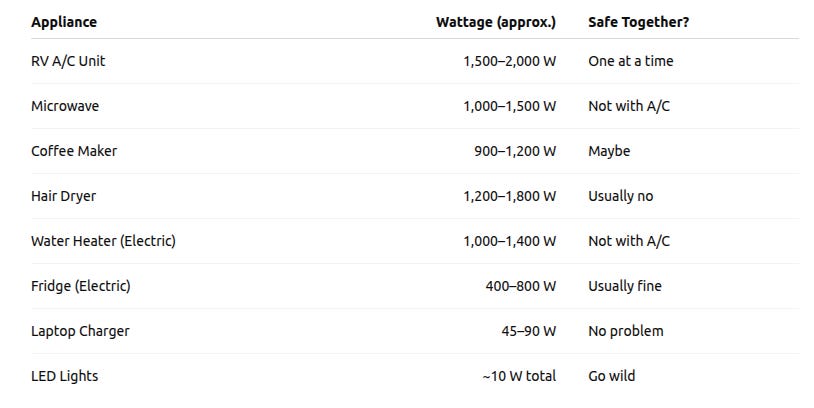
Pro Tip: If you’re plugged into 30 amps, pretend your rig is a juggling act. One heat-producing appliance at a time.
What Happens When You Overload It?
If you exceed your amp limit, you’ll trip a breaker, either at the pedestal (campground outlet) or in your RV’s panel. Worst case? You fry something expensive.
Keep a mental tally of what’s on.
If you need to run the A/C and microwave, turn off the water heater or other energy hogs first.
Tools That Make It Easier (But Aren’t Salesy)
Surge Protector – Protects against sketchy campground wiring. A must.
Multimeter – Handy for checking voltage or battery status.
Amp/Volt Display – Some RVs have them built in. If not, install a simple battery monitor to avoid surprises.
Bottom Line: Be Smart, Stay Powered
Your RV’s electrical system isn’t that complicated once you know what’s going on behind the outlets.
Stay under your amp limits, know what each power source can handle, and when in doubt, turn something off before turning something else on.
Because nobody wants to be the one flipping breakers while the kids ask when the A/C’s coming back on.
Got questions about your RV setup?
Or want a cheat sheet you can print and stick to the fuse panel?
Let me know, I’m putting one together.
Until next time, travel smart, and stay powered.